This one banking ratio is flashing a warning, but not a crisis

India’s banking system is sending an important liquidity signal that investors and policymakers are closely watching: the loan-to-deposit ratio (LDR), also known as the credit-deposit ratio. According to the latest data from the Reserve Bank of India (RBI), the system-wide ratio has climbed to a record 81.6% as of December.
In simple terms, the LDR shows how much of a bank’s deposits have been lent out. A higher ratio usually signals strong demand for credit, which is generally positive for economic activity. But when the ratio rises too much, it starts throwing up challenges.
Sustained levels above 80% are widely seen as a tight liquidity zone. While RBI does not impose a hard regulatory cap on LDR, staying in this zone for too long can slowly hurt margins, weigh on loan growth, and blunt policy transmission even if does not trigger an outright crisis.
The recent rise in the ratio is driven by two contrasting trends playing out at the same time.
On one side, loan growth has rebounded after a weak 2024-25 (FY25). Credit growth is now running at around 12%, supported by higher auto loans, unsecured retail lending, gold loans and increased lending to micro, small, and medium enterprises (MSMEs). Goods and services tax (GST) cuts and strong festive season demand have added to this momentum.
On the other side, deposit growth has slowed sharply and slipped into single digits. Many households are moving savings away from bank deposits toward higher-return avenues such as mutual funds and equities.
This widening gap between loan growth and deposit growth has steadily pushed the system-wide LDR up from 75.8% in June 2023 to the current 81.6%, indicating a structural change rather than a temporary spike.
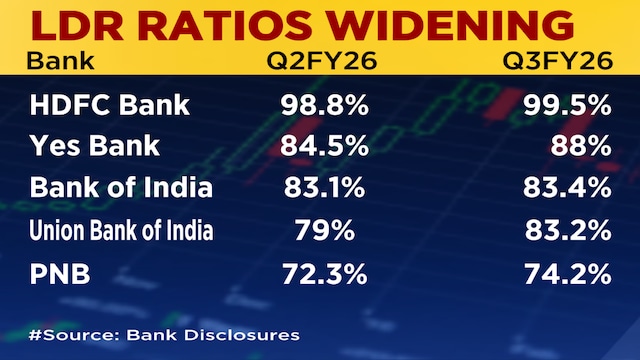
Recent provisional data from banks and research by Macquarie show that deposit growth is trailing loan growth by 250–300 basis points this quarter. This reverses the brief stabilisation seen in 2025 and highlights that the pressure is not limited to the overall system but is visible at the individual bank level as well.
For example, HDFC Bank’s LDR rose to 99.5% in the October-December quarter of 2025 (Q3FY26). Despite reporting relatively strong business momentum, the stock has faced pressure due to investor concerns over such a high LDR. Similar trends have been observed across other private and public sector banks.
Also Read: What to expect from India’s economy in 2026: Key signals from a CNBC-TV18 poll
A high LDR matters because it can restrict future credit growth once banks have largely deployed their deposits. It can also weaken the transmission of interest rate cuts by the RBI and squeeze banks’ net interest margins, as lenders may need to raise deposit rates to attract more funds.
That said, there is no immediate cause for alarm. Banks still hold excess statutory liquidity ratio (SLR) buffers, asset quality across the system remains stable, and credit growth is largely demand-driven rather than speculative.
In addition, the implementation of new liquidity coverage ratio (LCR) norms is expected to be eased from April 1, providing some relief.
Also Read: India’s Goldilocks economy faces softer glow in 2026: Growth, inflation and capital flows in focus
For now, the rising LDR is not a red flag, but it is a slow-burning risk and an important macro signal that deserves close monitoring.










Post Comment