Steel Secretary says no call yet on higher safeguard duty; licence misuse under scanner

The government has not yet taken a call on whether to impose a higher safeguard duty on steel imports beyond the provisional 12% currently in place, according to Sandeep Poundrik, Secretary, Ministry of Steel.
He said the final decision will depend on the outcome of the Directorate General of Trade Remedies’ (DGTR) investigation, which is expected to conclude by August.
“The safeguard duty which has been imposed right now is provisional for 200 days. Based on DGTR’s recommendations, the government will decide whether the duty should be higher, lower or remain the same,” he told CNBC-TV18.
In an interview with CNBC-TV18, Poundrik also confirmed that multiple cases of licence misuse have been identified, with legal action already underway.
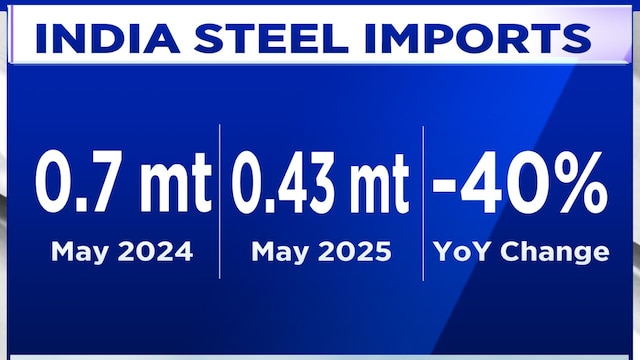
He noted that the government’s recent measures, including the provisional safeguard duty and stricter oversight, appear to be working. Steel imports in April and May have declined, and if the trend continues, annual imports could fall by nearly 50% compared to last year.
These are edited excerpts of the interview.
Q: You have put a safeguard duty of 12% but various reports suggest that because of the global turmoil and trade uncertainties, the steel ministry is considering hiking this. Could you clarify if there’s any truth to it?
A: No, I don’t think so. This is a process in which Directorate General of Trade Remedies (DGTR) makes recommendations based on its investigation, and it is conducting its final investigation, which is likely to conclude by August. The safeguard duty which has been imposed right now is provisional for 200 days. So DGTR will give its final recommendations based on whatever is the current status, whatever is the industry saying, whatever other stakeholders are saying, and then, based on that recommendation of DGTR, government will take a call.
Q: In the past, you have said you are plugging various loopholes with regard to steel imports. What’s the progress on that front?
A: There are various ways of importing steel. One is through Bureau of Indian Standards (BIS) licenses, where the steel has BIS standards. Then there are some other options, where there are no standards. In certain cases, which have come to our knowledge, people have misused the provisions. For example, one company has a licence, and multiple people have supplied steel based on that licence that has been confirmed in the investigation, and we are taking legal action, including recommending to BIS to cancel the licence.
We have also seen that in the Steel Import Monitoring System (SIMS) portal, people are trying to misuse the NOCs by trying to import different grades from which NOC was granted, or for using the same documents for importing multiple consignments of steel. So all those loopholes are being plugged in.
Q: Imports over the last two months have come down, and this is in the backdrop of Chinese exports moving up. Do you think that is the peak imports into India and we now have our measures in place? Also, do you stick to your earlier estimates of double digit steel demand this year?
A: On imports, there are two to three kinds. One is where the particular steel is not available inter country, like some specialty steels, grades so that’s all right, because those are not available. Second is based on lower price or dumping. That what the government has tried to discourage by imposing safeguard duty, and we have controlled to a large extent now.
Based on data of April and May, the total steel imports are much lower as compared to what they were in the last year. If this trajectory continues, the steel imports will be about 50% lower than last year, if not more. So that’s on the price sensitive or imports based on pricing.
There is a third category where some companies who have vertical integration with steel plants in their own countries that will continue in spite of safeguard duty, because they have a vertical integration, but that’s a smaller part of the overall basket.
On the consumption side, we are the only major economy clocking double digit growth. Last three years, we have been clocking about 12% growth. When the world steel growth is much lower at about 0.5-1%, India is a bright spot in the steel consumption scenario due to government’s push on infrastructure, private sector growth in real estate, buildings, the growth of the economy. I would also like to point out that we are at 104 kg per capita consumption. This is an inflection point because now our population is stabilising and our GDP is growing. So, the per capita will now increase much faster.
Same is for GDP to steel consumption growth elasticity. If you see the figures, for last three years, the elasticity has been somewhere around 1.7% to 1.8% while earlier, it used to be around 1% so both these factors greater elasticity of steel as compared to GDP, and much faster growth of per capita so India, is going to be okay, or rather good in consumption scenario.
Q: Where do you see the steel per capita consumption headed from 104 kgs now in the long term?
A: In 2024-25, it increased by 7 kg; from 97 kg we reached 104. By 2030 or so, we should be somewhere around 155-160 kg and by 2035 we should be around world average of about 200 kg plus. In next 10 years, we should reach the world average.
Q: What is the turnaround strategy for Rashtriya Ispat Nigam (RINL). How much money have you already spent and how much more do you plan to spend? Is the end goal that SAIL will have to buy it or will you do an IPO, or will it merge into some other entity?
A: RINL till now has been a success, In September, it was on the verge of closure. Now in May, they are running two blast furnaces above 100% and they have become cash positive for last three, four months. They are planning to start the third blast furnace in this month, so I anticipate that in next three months they will start generating sufficient surplus to meet their liabilities. We are also expecting that they will pay back much of their liabilities in next six months on the private sector side.
On the bank side, they have paid some part of their liabilities, and the banks have lowered their interest rate. So RINL is doing well for now. They have also reduced their manpower, regular through VRS as well as contractual so they are reducing their fixed costs. I am sure that they are on the right path. About the about the merger, or any other thing for now, it is that the government decision is to keep our RINL as a going concern so there is no proposal merger or any other things as of now on the table.
For full interview, watch accompanying video










Post Comment