KEI Industries CMD Anil Gupta optimistic of FY26, sees sustained demand
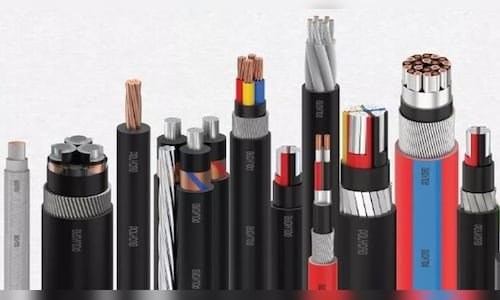
KEI Industries Anil Gupta, CMD is optimistic about the second half of the financial year 2026, with the company expecting 18–19% growth for the full year, driven by steady demand for wires and cables.
The management believes the strong momentum from the first half will continue, supporting their confidence in meeting the year’s guidance without difficulty.
New Delhi-based wires and cables company currently has a market capitalisation of about ₹39,628 crore, though the stock has dipped nearly 4% over the past year.
Below are the edited excerpts of the interview:
Q: What is the second half of the year looking like for your sector, and of course, for KEI, because up until now, it’s been steady demand for wires and cables. So, you tell us, what do you see ahead, and how do you expect the second half to shape up?
A: The second half of this financial year (FY26) is going as projected, and we expect an overall growth of around 18-19% in the full-year period. And the demand is strong, and I see no challenge in achieving the growth trajectory in the second half as well.
Q: Given you’re confident in growth. I believe at a recent conference you mentioned that, in fact, demand is strong, and getting to these numbers will be no problem. I think the following year you’re guiding for close to 20% growth as well, if I remember correctly.
A: From the beginning of the year, I mentioned a growth of 17 to 18% and we have delivered much more than that in the first half of FY26, and I am always conservative in my projections, so I don’t want to overproject. We should be able to achieve whatever I have said.
Q: Give us a sense in terms of exports, you know, on a low base that did see a good uptake. So, if you could tell us how things are looking out there? And I believe the exports to the United States have been weak, obviously because of tariffs, but in Europe, you are seeing some kind of traction out there. So, fill us in on that front. And, if you could help us out with the margin difference between domestic and exports.
A: The export business remains strong in all our export markets — Europe and the Middle East, as well as Australia. And so far, as the US is concerned, yes, our projection was strong this year, but it has slowed because of the tariffs, but we are able to make up the shortfall from other markets. Regarding margins, there is a margin difference of 1-1.5% in export markets, better than the domestic market. And as we are building up capacities, we will be able to grow our export business as well as margins with economies of scale.
Q: You’re guiding that exports will be in the high teens, right? As a percentage of the mix, 18 to 19% of the total mix is what you’re looking at. On a year-to-year basis, you’re expecting margins to improve as well for the company, by around 75 to around 100 basis points for the coming year, FY27 as well, in comparison to FY26.
A: Yes.
Also Read: Housing wire demand could rise 5-10% as GST cuts free up spending: KEI Industries
Q: Just one quick point. I want to continue that margin point. You don’t think—and we’ve discussed this in the past as well, right? And I think you were the one who told us once—when copper prices go up and there’s an unprecedented runaway move, if there is an unprecedented runaway move, what it does is, I mean, it’s, of course, passed through, and there’s hedging, etc., but it kind of impacts volume of work, etc. And we had KEC recently, who kind of alluded to that as well. Anything you can tell us on this?
A: The pause comes only for a short period because the contractors who might have taken contracts on firm prices, they think that prices will go down, and they try to wait for the placement of new orders, but eventually they can’t wait for more than a month or two, so eventually the demand comes back. So far as margins in a rising market are concerned, my observation over several years is that it may impact around half a percent plus or minus, depending on the market situations or market sentiments.
Q: So, this guidance which you’ve given out, which is for improvement, that considers all of this, the copper price rally, etc.?
A:
Yes, we always take that into account, and we have delivered even a revenue volume growth of 15% in the first half. So, it is not just the turnover by way of prices, but we always observe the volumes, not just the value.
Q: Since we’re talking margins, one obviously added component of that conversation must be what the competition is doing. And the earlier part of this year was spent really discussing the deep-pocketed large business conglomerates that are getting into your space. Now I don’t know where things stand. I’m not quite sure if that product has already hit the market—the Adanis, the Birlas—and if it has, if it has started showing up in any way, can you just update us on what’s happening with respect to competition from these other large players?
A: So far, no one has entered the market, neither UltraTech nor Adani, and I had said in my earlier interviews also that even if they enter, I am sure that our growth will not be impacted. We are working on our growth based on larger territories and geographies and larger markets and segments and product lines, instead of just focusing on traditional product lines of the construction and building industry.
Q: What I was just asking—I mean, you have your ear to the ground. So, what are your channel checks indicating? They announced their plans in March of 2025; now we’re at the end of 2025, so what are the channels saying? Will there be a presence? And then, of course, we’ll see how competition plays up. And you all have been old-time players, old-time hands. So what timelines are we looking at when this competition becomes real in the market?
A: In my opinion, it takes a minimum of two years to build up a plant and launch the product. So much time anyone is going to take. That is for wires, and for cables—if it is medium-voltage or high-voltage cables, it is more. So, next year also, we don’t see much impact due to them.
Q: On a side note, I mean, just a different tangent. I’m just asking this: the fact that there is a huge data centre buildout that started in India, and we know that power is a huge part of it, and a lot of the power equipment suppliers, transmission companies—they’re seen as a bit of a play on this data centre buildout. Can you tell us if this has any direct implications for you?
A: Of course. I mean, every demand coming from any sector has a cascading effect on the demand, and data centres require a power source or an energy source from three different sites. So firstly, the incoming power demand increases. Incoming demand for cables increases to bring the incoming energy. And, within the data centre, there is a substantial requirement for wires and cables to interconnect their panels or systems. So, it is driving the demand. But, I mean, this is just one of the sectors which we cater to.
Q: I don’t know whether you have a number on hand, but I believe one of your competitors, Polycab, said that for one megawatt of setup of data centre capacity, the total cables and wires demand will be around three and a half crore approximately. Do you have any rough numbers in terms of a metric out there? And that’s why they believe that this data centre push, with the 656 MW of data centre addition, will be a big tailwind for the industry. Do you have a rough metric out there?
A: I agree with it, but I don’t have the actual numbers for how many wires and cables will be consumed with one megawatt. But I agree with this number.
Q: How much do data centres right now contribute to your revenue? I mean, I am just trying to get a sense of your exposure to data centres and how you see that growing.
A: We have not quantified the numbers which are going to data centres.
Q: Tell us about this: the GST cuts that we have seen are supposed to propel some kind of demand for housing buyers. Have you seen signs on the ground out there? If you could help us out with that. What would the ideal mix for you be between cables as well as wires? If you could tell us that. And expansion is on stream, right? Sanand, I believe next week you’re going to cut the ribbon out there. Is that correct?
A: Yes, we are going to commence production next week, the first week of December. And so far as this wire segment due to GST is concerned, I don’t think that we are able to quantify it so far, because up to last month was the festival month, and November is just going on. So, we will quantify it. I will let you know in the next conversation what the impact of the GST cut is on the wire sale.
Q: But demand is strong enough – that’s all you’ll have to say regarding cables as well as wires.
A: Demand is strong enough, and demand is basically related to construction activities. I mean, I don’t think that just because of some GST cut, somebody is going to buy the wires just to keep them.
Q: Give us the rough breakup about how you see the wires and cables mix progressing from here on?
A: Our cable mix will remain 75% and wires and flexible will be around 25%.
Watch the interview in the accompanying video










Post Comment